
Before they were haunted
How good intentions failed in early prisons and mental institutions

A few years back, I started to discover an odd pattern among many abandoned and supposedly haunted former institutions: when they were built in the late 19th- or early 20th-century, they were often thought to represent innovative new designs that would revolutionize treatment and housing of the mentally ill and the poor. Built with the best intentions, these places all seemed to thrive at first, but swiftly degenerated into overcrowded and inhumane hellholes before permanently shutting down a century after their construction. Now they leave behind tragic histories of abuse and neglect that have mutated into stories of angry ghosts roaming ruined grounds.
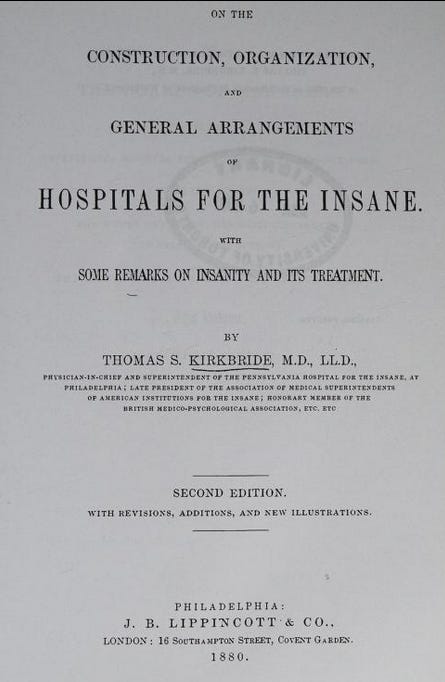
Many of the institutions built in the 19th- and 20th-centuries employed something known as the Kirkbride Plan. This was created by the 19th-century psychiatrist Thomas Story Kirkbride, and was designed to do away with the almshouses that had treated impoverished patients in the past, replacing them with architectural designs that incorporated light and fresh air, two elements believed to assist in treating the mentally ill; Kirkbride also suggested abundant landscaping around the buildings, in order to provide residents with the chance to be productive by assisting in farming and gardening. Beginning with Trenton State Hospital in New Jersey in 1848, 73 facilities around the United States were built utilizing the Kirkbride Plan, but by the 20th-century the Plan was falling out of favor. Critics disputed Kirkbride’s theories regarding treatment, and his massive architectural layouts proved economically unfeasible (Kirkbride suggested that facilities be built on lots of at least 100 acres). Also, given their size, staffing was difficult, especially as budgets were cut over time.
Some of these facilities have been completely demolished and replaced, some are still active, and some are abandoned and at least partially ruined. Quite a few, most famously Trans-Allegheny Lunatic Asylum in Weston, West Virginia, are thought to be extremely haunted, and have provided episodes of various paranormal investigation television shows. Even those that have been completely flattened or replaced by modern structures retain shadows of the past.
Here in Southern California we have one facility that was constructed under the Kirkbride Plan and is still in operation: Patton State Hospital in San Bernardino. Now a high-security institution, Patton isn’t open to the public (except for a museum on the grounds), but staff have (as expected) reported unsettling occurrences, including seeing shadow figures.
Closer to L.A. is an abandoned facility in Downey called Rancho Los Amigos, which seems like it might have employed at least elements of the Kirkbride Plan. Established in 1888 as the Los Angeles County Poor Farm, it promised grand things at first, but soon degenerated into squalid conditions. Fortunately Rancho Los Amigos had some good early superintendents who were able to expand and renovate it, and it maintained a good reputation for decades, with its farms producing enough to not only provide for the residents but also sell to the surrounding areas. Although part of Rancho Los Amigos (designated as the North Campus) still functions, much of it was abandoned in 1988. For years the area was simply left open, and urban adventurers would report strange experiences inside the old buildings. Over the last 30 years, though, the buildings have fallen victim to arson, weather, and time, and the entire area is now fenced off.
One of the things I find fascinating about these sites is how they provide a behind-the-scenes look into haunted places. If you’re a believer, their history of misery, rage, and death - many patients, after all, died at these institutions, often as a result of mistreatment - makes for a perfect breeding ground for ghosts. If you’re a skeptic, these places represent a sort of collective horror and shame at a past age, and even the most cynical of non-believers can’t help but feel a melancholy tinged with the eerie while visiting these spots.
On a personal level, I’ve never visited a Kirkbride Plan location, and I wish I’d been able to visit Rancho Los Amigos before it was fenced off. I have, however, stolen the Kirkbride Plan and used it in a short story, “The Naxon Plan,” for the upcoming anthology Abandoned: Asylum, based on editor James Chambers’ photographs of the abandoned King’s Park Psychiatric Center, which was another facility built in 1885 that, while perhaps not strictly built on the Kirkbride Plan, borrowed many of its central ideas, to say nothing of the usual tragic history of these institutions. When Jim originally showed me his photos and asked me if I’d like to contribute a story, I knew immediately that I’d be riffing on The Kirkbride Plan.

If you’d like to know what I ended up doing in “The Naxon Plan,” please consider becoming a backer for the Abandoned Asylum on Kickstarter. There are some cool rewards for backers at different levels, plus this is an experiment for publisher Raw Dog Screaming Press and if it works we hope they’ll do more anthologies!
Truly appreciate the breadth of this piece, Lisa, and the empathy for those who suffered in the places. I look forward to reading your story.
Lisa! I LOVE this piece! And I particularly love this portion: "If you’re a believer, their history of misery, rage, and death - many patients, after all, died at these institutions, often as a result of mistreatment - makes for a perfect breeding ground for ghosts. If you’re a skeptic, these places represent a sort of collective horror and shame at a past age, and even the most cynical of non-believers can’t help but feel a melancholy tinged with the eerie while visiting these spots." Are you a believer, or a skeptic? And what is it about the late 19th century that promoted "nature cures"? And why did things turn so ugly in the 20th? I'm thinking, too, about the treatment of alcoholism here. In the 19th century, the "nature cure" was promoted, but by the 20th, the trend was toward lobotomy, electro-convulsive therapy and other unpleasant propositions. I'm curious, too, whether Cal State Channel Island – the former Camarillo State Mental Hospital – is haunted? Thank you for this piece!