TRIGGER WARNING: This piece contains descriptions of violence against both humans and dogs
If you’re a fan of the paranormal, then chances are that you know about the Villisca Ax Murder House.
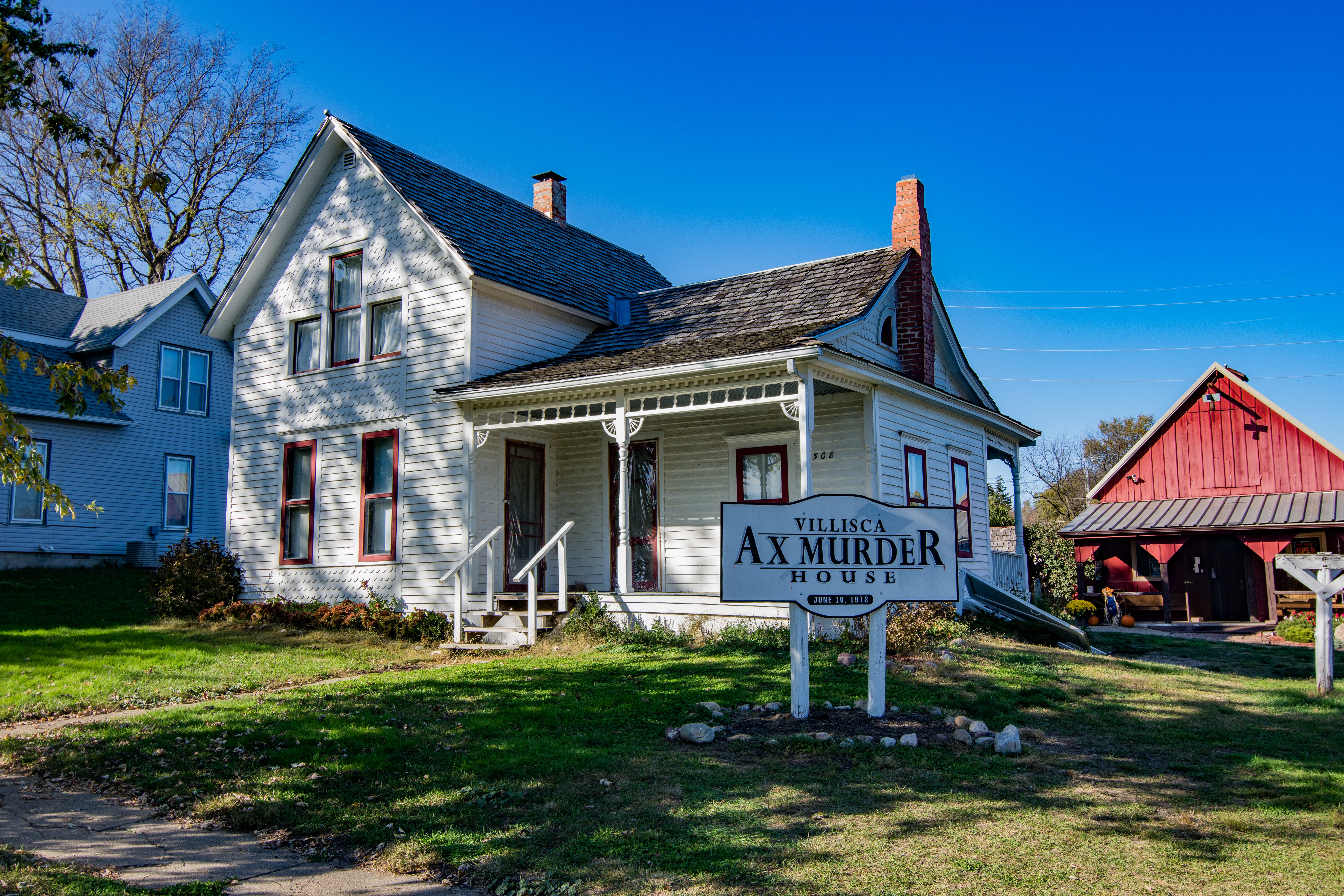
Located in the Iowa heartland just over an hour’s drive southeast of Omaha, this town of 1,132 (according to the 2020 census) is notable for one thing: a terrible crime in 1912 that led to a notorious haunting. On the evening of June 9, 1912, six members of the Moore family and two children staying with them were brutally murdered, a slaying that went unsolved. The house, which still stands, is now reputed to be one of the most haunted in America, with – as would be expected – most believing that the spirit(s) residing there is(are) particularly active.
Writers/researchers have been writing about the Villisca murders for years. The most exhaustive examination must surely be the 2017 book The Man from the Train, by sports writer Bill James and his daughter Rachel McCarthy James. At this point, nearly everyone agrees that the slayings in Villisca were the act of a serial killer; although there were suspects galore at the time (pretty much anyone who’d ever had a cross word with the Moores), nothing ever came of looking at locals. So, if this was the act of a random killer, they must have struck again, right?
Oh yes. For The Man from the Train, the authors broke down the peculiar, distinctive circumstances of the Villisca murders and searched thousands of old newspapers for similar accounts.
They found them. In fact, they found a lot, ranging across the United States (and possibly into Europe). They believe the murder spree began in 1898 with a Massachusetts family, the Newtons, who were employing a handyman named Paul Mueller. After the Newtons were found slain, Mueller vanished…and two years later, the bloody chain picked up in New Jersey, eventually finding its way to Villisca twelve years later. During that time, they theorize that Mueller murdered well over a hundred people.
Here are the unusual parts of the Villisca killings that they found happening over and over: they looked first for murders of entire families (or at least entire households). The house where the murders occurred must have close proximity to train tracks, since the killer likely rode the trains to escape (bonus points if the scene of the crime was near an intersection of two or more tracks, since that would’ve provided even more opportunity for passing trains to hop). The killings always involved an axe, suggesting the perpetrator was skilled at working with wood, so they gave special emphasis to crimes that occurred near logging communities. And the homes needed a barn or outbuilding where the killer could hide, watching and waiting until the family was tucked into their beds at which point he entered the house through a window.
Now here’s where it gets weird:
The crimes usually happened on Sundays
Doors inside the homes were jammed from the inside
The windows were covered
A lamp would be found with the upper glass hood removed
Nothing was stolen
The faces of the victims were covered
A prepubescent daughter was usually in the family
The bodies were often found stacked atop each other
The murders were committed using the blunt side of an axe, not the blade (meaning the victims were bludgeoned, not chopped), probably because this didn’t slow the killer down by risking the blade getting stuck in something
When the Jameses applied these odd characteristics to their searches, they found far more matches then they expected, and believed they could all have been committed by Paul Mueller, a German immigrant known to have had a bad temper. Evidence (a size 6 footprint) and supposition (a tall man would not have been able to swing the axe overhead in some of the small rooms) led to the belief that the murderer must be short, and Mueller was short.
Author Troy Taylor, who wrote about the Villisca killings in his book Murdered in Their Beds, doesn’t buy the Paul Mueller theory – he thinks that too many of the murders the Jameses laid on Mueller don’t match enough of the criteria (their explanation is that Mueller was learning and refining); but he still believes a serial killer was behind the Villisca slayings, and he gathers evidence surrounding a half-dozen similar crimes around the Midwest and into Colorado. He calls his perp “Billy the Axeman,” an epithet used by some newspapers at the time.
In The Man from the Train, the authors also make the chilling point that the murderer – whether Mueller, Billy, or someone else – may have committed even more atrocities that we don’t know about because both newspapers and policing were still relatively primitive at the time. Few rural communities of the kind where the killings took place had anyone nearby skilled at homicide investigation; instead, these neighborhoods relied on rewards and private detectives who were often only too happy to frame someone to collect the reward money. This roaming serial killer, then, left not only victims he’d personally destroyed, but also collateral damage in the form of innocents who were incarcerated or even executed for his crimes.
Another problem was that the idea of serial killers was still difficult to believe. When killings like these were discovered, those in the area began to recall disagreements with the dead and point fingers at any who might have ever had even a minor argument with the deceased. No one wanted to believe that these acts could be random. That violates too much of the universe’s order.
But so do ghosts.
So, here’s the question all of the above has been presented in order to pose: if the Villisca murders were committed by a serial killer who also committed similar horrors in other places, are any of those locations also thought to be haunted?
The answer is: no, with one odd exception.
The odd exception comes from Colorado Springs, where nearly all the experts agree that the same man who killed the Moores and their visitors in Villisca slew the Wayne and Burnham families in September 1911 (for a total of six victims).
Now, here comes the first of a number of bizarre coincidences that are about to pile up: there was something else going on in that area of Colorado Springs that September, and that something else was a dog killer on the loose. Someone was feeding strychnine-laced sausage to the local canines, including a beloved mascot of the local high school. When the Burnham family dog was killed and then left on the front lawn to decay, family members went into the house to check and found the humans also dead; after police were brought in, they discovered the Wayne family in the next-door house had also been slaughtered. A few days later a man named Anthony Donatello was arrested; a butcher by trade, neighbors claimed Donatello had also been in love with the late Alice Burnham. When police searched Donatello’s home, they found the place decked out in dog skins. Donatello was later released because the human murders couldn’t be pinned on him.
Now, more than a century later, people in the neighborhood say they still hear the sound of dogs howling in terror.
However, there are no other human hauntings – at least that I could find – connected to the Paul Mueller/Billy the Axeman slayings.
Why? If the Villisca house is haunted – by its victims, its killer, or both – why wouldn’t any of the other crime scenes be?
A medium or ghost-hunter might offer any number of suggestions to answer this. It’s not impossible that this was the killer’s final massacre, although Taylor believes he committed at least one more murder in 1914 (the Mislich family of four in the Chicago suburb of Blue Island), and the Jameses hypothesize that he may have fled America to return to Germany, where he committed a famed crime in 1922 known as the Hinterkaifeck murders, in which a family of six was bludgeoned (other aspects of the murder also bore a resemblance to the American murders, including the stacking of bodies).
Or…were the killings in Villisca his final heinous act before his own passing, and so his spirit took up residence there?
Or…is there something even darker and older lurking in Villisca, a theory that the mediums in the Scared and Alone investigation (see below) brought up?
As a skeptic, my theory is rather simpler: the Villisca house is the one thought to be haunted because it’s the only original home from the murder chain that’s still standing.
Most of the families this killer destroyed were on the poorer side of the American middle class, and so resided in homes that weren’t built to last. Take a look, for example, at the house where the Showman family was bludgeoned (in Ellsworth, Kansas) eight months before the Moore family in Villisca:

The Villisca house was built in 1900 and had a number of owners until it was purchased in 1994 by Darwin and Martha Linn, who opened it as a tourist attraction. Like any other old house, this one’s had decades of remodeling; the Linns cleaned some of that out, restoring the house as much as possible to its 1912 conditions (which included removing vinyl siding, electricity and plumbing). In 2024 it changed ownership and is now operated by US Ghost Adventures.
In other words…it’s a classic old building, with the creaks and age that often accompany hauntings.
My question is this: if ghosts are energy, why would they need to be tied to a specific structure? If there was a modern tract home built on the same ground where an atrocity had occurred (as is the case in most of the slayings recorded in possible connection to Villisca), why wouldn’t that new house be haunted?
Believers in Stone Tape Theory – that certain materials may record traumatic events and replay them to sensitives – would be right in suggesting that the Villisca house meets their criteria. Investigators to the house report contact with both victims, principally the six children killed with the two adult Moores, and the killer. Most of the paranormal events recorded within the house are classic: the sound of footsteps, the feeling of pressure or oppression, and temperature drops.
Again…it all sounds like a creaky, drafty old house, doesn’t it?
Finally, let’s return to the bizarre coincidences I mentioned above, and look at something that happened six months after the Villisca family slayings. In Columbia, Missouri (not that far from Villisca), two women were murdered a few days before Christmas. The women, who were mother and daughter, were named Georgia Moore and Mary Wilson. The women were killed with an old axe, but the similarities to the other killings end there. Mary’s son Henry Lee Moore was arrested for the crimes (he wanted the house and money), tried and found guilty, and sentenced to life imprisonment.
The biggest coincidence, though, isn’t the name “Moore” popping up over and over.
In 1913, investigators began to look at Henry Lee Moore as a possible suspect in the other killings, especially the Villisca set. When a photo of Moore was shown around Villisca, Joseph Stillinger – father of the two murdered girls who had been staying with the Moores on the night they were all murdered – said the photo looked like a man he’d hired in April of 1912 who had worked for him for a week. That man gave his name as “Hellum.” At the time, authorities suggested this might have been Henry Lee Moore vocalizing his initials as a fake name.
But here’s something else: the name is almost “Mueller” backwards.
Look, I’ve already called this a coincidence, and I believe that’s what it is. I’m not claiming to have found some previously-overlooked clue here. I recognize this as a cousin of pareidolia, that tendency of our brains to look for patterns where none exist. We want things to be orderly, not chaotic. This is why we find a ghost in light and shadow, or hear a message in the white noise of an EVP recording.
But…that part of my brain that wants this to make sense doesn’t want to let it go. It’s telling me that we know Mueller had worked as a handyman (for the Newton family, before he butchered them), that the killer’s whereabouts from June 1911 (when the Hudsons were murdered in Paola, Kansas) to June 1912 are unaccounted for in The Man from the Train’s timeline, that he could easily have seen the Stillinger daughters (or, for that matter, the Moore children) while working for their father and become obsessed, that he was likely just smart enough to not use his real name but not smart enough to come up with something better than his real name reversed, that he might have said “Rellum” but his accent rendered it as “Hellum” (or he might have been amused by changing the “Rell” to “Hell”), and that Henry Lee Moore had used the fake name “L. Smith” upon occasion, not “Hellum” (Mr. Moore should also be excluded from consideration as the Villisca murderer by virtue of his intelligence - he left blood all over his hotel room after slaying his mother and grandmother).
I know this took a strange left turn away from consideration of how a serial killer’s horrible acts might turn into serial hauntings, but hey…sometimes life doesn’t make sense the way we want it to.
Scared and Alone at Villisca
The producers of my Ghost Report podcast are also the mad geniuses behind a web series called Scared and Alone, in which plucky paranormal investigator Courtney Buckley (amusingly labeled in the show as “Ghost Bait”) ventures into a haunted location alone, although she’s accompanied virtually by guest mediums and live viewers.
In 2023, an episode was shot inside the Villisca house. During the course of the two hour livecast, Courtney heard footsteps, found a bag she’d brought with her had been moved, had crazy readings from her K-2 meter, and felt increasingly unwell. As the show progressed, the commenting mediums believed they encountered the spirits of both the murdered children and something (with red eyes) darker and older than even the killer.
About 50 minutes in, something really strange does happen: a wash of white noise, similar to what comes out of a spirit box, crashes into the soundtrack for no obvious reason. It’s finally located as emanating from the microphone of G.G., who is also in Villisca but stationed outside the house, near the barn.
While this trip through a murder house is unlikely to convince any skeptics, it’s nonetheless compelling viewing and a good look inside the house. I especially enjoyed watching Richard-Lael Lillard (“The Gentleman Psychic”), who is one of the sidebar mediums, create a striking painting during the video.
COMING UP…
We’re going to take a look at history’s first great seance: when Odysseus called up the spirits; and we’ll dig into the creation of the greatest ghost story ever written, A Christmas Carol!
THANK YOU for subscribing, and as always let me know if you’d like to see more/less/whatever here!